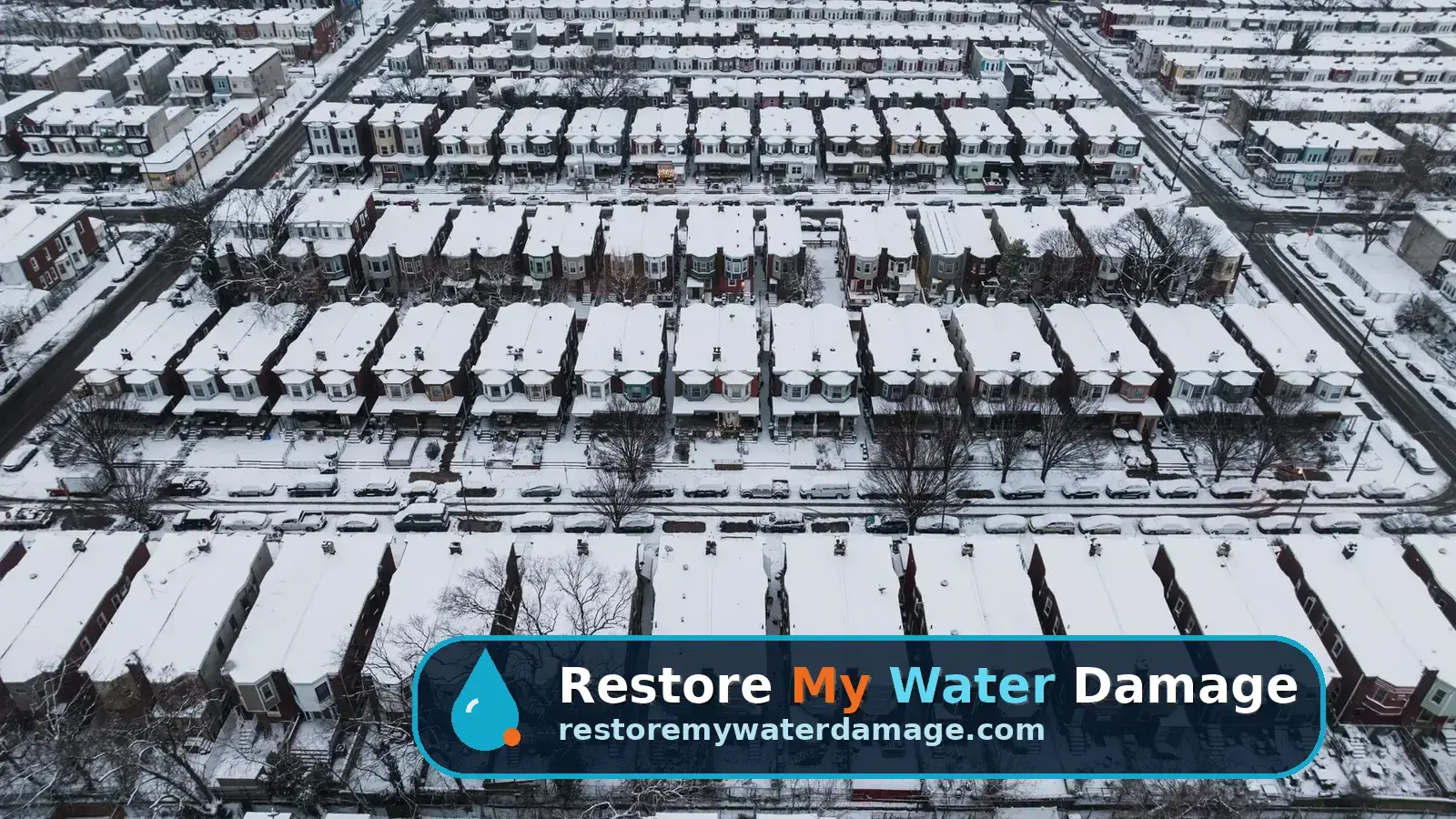
Philadelphia properties face a distinct mix of water problems. Much of the city's housing stock is more than a century old, with shared party walls, below-grade basements and plumbing that has been patched and replaced in stages over decades. When water gets loose in a rowhome, it rarely stays in one room, and sometimes it does not stay in one house.
Restore My Water Damage connects Philadelphia homeowners, landlords and property managers with water damage restoration help: water extraction, moisture mapping, structural drying, removal of damaged materials and cleanup after contaminated water. Whether the source is a supply line that failed on the second floor, a basement that took on water during a summer downpour, or a floor drain that backed up, the goal is the same: stop the water, document the loss, dry the structure properly and limit secondary damage such as mold.
Because Philadelphia buildings are so often connected, restoration here usually means thinking beyond your own four walls. A leak can travel into a neighbor's wall cavity, and a basement backup may be tied to conditions in the street. This page covers the causes of water damage that come up most often in the city, what the property mix means for drying, and practical steps to take before help arrives. For immediate help, see our emergency water damage restoration service or call (833) 435-4276.
Water Damage Restoration Services in Philadelphia
Water damage restoration in Philadelphia covers the full sequence from the first call to the final repair: stopping the damage, removing water, drying the structure to measurable dry standards, cleaning affected materials and rebuilding what cannot be saved. Every job is different, so the scope is set after an on-site inspection, not over the phone.
Emergency Water Damage Cleanup
The first hours matter most. Standing water spreads into drywall, subfloors and cabinets, and wet materials can support mold growth within roughly 24–48 hours. Emergency work focuses on safety checks, stopping further damage and getting extraction started. Learn more about emergency water damage restoration.
Water Extraction and Structural Drying
Extraction removes liquid water far faster than evaporation ever could. Drying then uses air movers and dehumidifiers placed according to moisture readings, with daily monitoring until materials reach their dry goals. See water extraction and structural drying.
Water Damage Repair and Restoration
Once the structure is dry, damaged drywall, baseboards, flooring, cabinets and paint are repaired or replaced. Some property owners use one company for both mitigation and rebuild; others hire a separate contractor. Read about water damage repair and restoration.
Fire and Water Damage Restoration
After a fire, water from sprinklers and hoses often causes as much damage as the flames. Drying and soot cleanup must be coordinated so moisture does not set smoke residue deeper into materials. See fire and water damage restoration.
Mold-Related Water Damage
When water has been present long enough for mold to grow, the job follows containment and removal practices described in the IICRC S520 standard. Ask whether mold remediation is available for your address when you call. More on mold and water damage.
Common Causes of Water Damage in Philadelphia
Across Pennsylvania, the most common drivers of water damage are frozen pipes, basement seepage, nor'easters and remnants of tropical storms. The local factors specific to Philadelphia are covered below.
Aging rowhome plumbing and shared walls
Philadelphia is famous for its rowhomes, and many were built in the late 1800s and early 1900s. Over the years, original galvanized steel and cast-iron lines have been partially replaced with copper, PVC or PEX, often leaving a patchwork of materials and joints. Galvanized supply pipes corrode from the inside, and old cast-iron drain stacks can crack along their length. Because rowhomes share party walls, a slow leak inside a wall cavity can go unnoticed until staining appears, sometimes on the neighbor's side first. Second-floor bathrooms stacked over kitchens are a common trouble spot: a failing wax ring, shower pan or supply line can soak a ceiling and the plaster and lath beneath it.
Frozen pipes in exterior walls and unheated spaces
Philadelphia winters swing above and below freezing, and a hard cold snap is enough to freeze pipes running along exterior walls, under rear additions, in unheated back kitchens or in basements with poorly sealed windows. Vacant rental units and properties between tenants are especially vulnerable when the heat is turned down. The damage usually shows up when temperatures rise and the ice thaws, so a pipe that split overnight may not start flooding until the next afternoon. Our burst pipe water damage cleanup page explains what happens next.
Heavy rain, combined sewers and basement backups
Much of Philadelphia is served by a combined sewer system, where stormwater and wastewater share the same pipes. During intense rain, those pipes can become overwhelmed, and water can push back up through basement floor drains, laundry tubs and low toilets. This is why a basement can take on dirty water even when no river is anywhere near flood stage. Backflow from a sewer line is considered contaminated water and calls for protective equipment, removal of porous materials and disinfection. See sewage backup cleanup for how that work is handled.
Remnants of tropical storms and river flooding
The remnants of Hurricane Ida in September 2021 showed how quickly a tropical system can overwhelm the region. The Schuylkill River rose to major flood levels, flooding streets in Manayunk and parts of the Schuylkill corridor, and sections of the Vine Street Expressway were submerged. Neighborhoods along the Schuylkill, the Delaware, and creeks such as the Wissahickon, Pennypack and Frankford can see flash flooding when heavy rain falls quickly. Floodwater from rivers and streets carries sediment and contaminants, so it is treated differently from a clean-water pipe leak. Our flood damage restoration service covers this category of loss.
Flat roofs, parapets and apartment buildings
Many rowhomes and small apartment buildings in Philadelphia have flat or low-slope roofs with parapet walls. Clogged drains, aging membranes and failed flashing at the parapet let water in during wind-driven rain and nor'easters, and the leak often shows up on the top-floor ceiling far from where it entered. In converted multifamily buildings, a single overflowing tub or failed water heater can affect several units below. Coordinating access, documentation and drying across units is a regular part of restoration in the city.
Burst or Frozen Pipes
Cold snaps can freeze water in exterior walls, crawl spaces, garages and attics. Ice expands, the pipe splits, and the leak often appears only after thawing. Keep the main shutoff location known, insulate vulnerable runs and let a trickle run from exposed faucets during hard freezes.
Appliance and Plumbing Leaks
Water heaters, dishwashers, ice-maker lines, washing machines and toilet supply lines fail in every market. These are usually Category 1 (clean) water at first, but water that sits or contacts flooring and debris can degrade to Category 2 or 3.
Basement Seepage and Sump Pump Failure
Where basements are common, heavy rain raises groundwater pressure against foundation walls. A failed sump pump or power outage during a storm can put inches of water on the floor within hours.
Sewer or Drain Backups
Tree roots, grease, collapsed lines and heavy rain overwhelming municipal systems can push sewage back into a property. This is Category 3 water and requires protective equipment and removal of affected porous materials. See sewage backup cleanup.
Types of Water Damage We Handle
Restoration professionals classify water by contamination level using the IICRC S500 categories, because the category decides what can be dried in place and what must be removed.
| Category | Typical sources | What it means for restoration |
|---|---|---|
| Clean water (Category 1) | Broken supply lines, faucet overflows, fresh rain intrusion | Most materials can often be dried in place if work starts quickly |
| Gray water (Category 2) | Washing machine or dishwasher discharge, toilet overflow without feces | Carpet pad and some porous materials usually removed; cleaning and antimicrobial treatment |
| Black water (Category 3) | Sewage, rising floodwater, water standing long enough to grow bacteria | Porous materials generally removed; PPE and containment required |
For a deeper explanation, read water damage categories explained.
The Water Damage Restoration Process
A professional restoration job in Philadelphia follows the same measurable sequence used nationally. The details of each step change with the size of the loss and the materials involved.
1. Emergency Assessment
The technician confirms the water source is stopped, checks electrical and structural hazards, identifies the water category and drying class, and photographs conditions before work begins.
2. Water Removal / Extraction
Truck-mounted or portable extractors remove standing water from floors, carpet and pad. Thorough extraction can shorten drying time by days.
3. Moisture Detection
Pin and pinless moisture meters, thermo-hygrometers and thermal cameras map where water has traveled, including inside walls and under flooring.
4. Drying and Dehumidification
Air movers increase evaporation while dehumidifiers pull that moisture out of the air. Readings are logged daily until materials reach dry standards.
5. Cleaning and Sanitizing
Affected surfaces are cleaned, and antimicrobial products are applied where the category warrants. Unsalvageable materials are removed and documented.
6. Repairs and Reconstruction
Drywall, insulation, trim, flooring and paint are restored. The full restoration process guide explains each step in detail.
How Long Does Water Damage Restoration Take?
Drying a typical water-damaged room commonly takes about three to five days once equipment is in place, though dense materials such as hardwood and plaster can take longer. Repairs add days to weeks depending on scope, material availability and insurance approvals.
Timelines depend on how quickly work begins, the amount of water, the materials that got wet, the water category, and indoor humidity. Drying should end when moisture readings say the materials are dry, not on a fixed calendar date. See how long water damage restoration takes.
How Much Does Water Damage Restoration Cost?
There is no single price for water damage restoration in Philadelphia. Cost depends on the affected square footage, water category, materials, how long the water sat, equipment days, and whether repairs are included. A written estimate should follow an inspection.
- Size of the affected area and how many rooms or floors are involved
- Water category — sewage and floodwater require more removal and protective work
- Materials — hardwood, plaster and cabinetry take longer and cost more to dry or replace
- Drying time and the amount of equipment needed
- Repairs and rebuild, which are often priced separately from mitigation
Commonly reported national figures are explained in our water damage restoration cost guide.
Does Insurance Cover Water Damage Restoration?
Many homeowners policies cover sudden and accidental water damage, such as a burst pipe, but commonly exclude gradual leaks, poor maintenance and flooding from outside. Flood damage generally requires a separate flood policy. Always read your own policy and confirm with your insurer or adjuster.
Document the damage with photos and video before cleanup, keep receipts, and take reasonable steps to prevent further damage. Restore My Water Damage can provide moisture logs, photos and itemized scope documentation for your claim. Read water damage insurance claims for a step-by-step walkthrough.
Residential vs. Commercial Water Damage Restoration
Philadelphia's property mix is dominated by attached housing: traditional rowhomes, twins and trinities in older neighborhoods, alongside newer townhouse construction in areas that have seen redevelopment. Many of these homes have been converted into multiple apartments, which means one water event can involve an owner, several tenants, a property manager and more than one insurance policy.
For residential restoration, attached construction changes the drying plan. Plaster walls, hardwood floors laid over subfloors, and masonry party walls hold moisture differently than drywall over studs. Moisture meters and thermal imaging help confirm whether water has migrated into an adjoining wall, and drying equipment may need to run longer in dense masonry. Narrow floor plans and steep staircases also affect how equipment is brought in and how damaged materials are removed.
The city also has a large commercial footprint: high-rise offices and condominiums in Center City, university and hospital buildings, restaurants and retail storefronts along commercial corridors, and industrial and warehouse space in areas along the rivers. In these settings, restoration often has to work around occupants and operating hours, coordinate with building engineers, and protect shared systems such as elevators and electrical rooms. Our commercial water damage restoration page covers what businesses and property managers should expect.
For mixed-use buildings with a storefront below apartments, both perspectives apply at once. Clear documentation of where the water started, which areas were affected and what was removed helps everyone involved sort out responsibility and insurance claims.
Homes and commercial properties follow the same drying science, but commercial jobs add tenant coordination, business continuity planning and larger equipment deployments. See residential and commercial water damage restoration.
Why Choose a Professional Water Damage Restoration Company
Professional restoration is about measurement and documentation. Household fans and shop vacuums can move surface water, but they cannot confirm that wall cavities and subfloors are dry. Hidden moisture is what leads to mold, warped floors and repeat repairs.
- Ask whether technicians are trained to the IICRC S500 standard and request proof
- Expect written moisture readings and a drying log
- Get a written work authorization and scope before large removals
- Confirm insurance coverage and applicable state or local contractor licensing
Use our guide to choosing a restoration company to compare providers.
Areas and ZIP Codes We Serve
Philadelphia is both a city and a county, running from the Delaware River west past the Schuylkill River. It includes Center City, South Philadelphia, North and West Philadelphia, the Northeast, and northwest neighborhoods such as Manayunk, Roxborough, Germantown and Chestnut Hill. This page covers 128 ZIP codes across 38 communities, including Abington, Aston, Bensalem, Brookhaven, Cheltenham, Chester, Chester Heights, Clifton Heights, Crum Lynne, Darby, Drexel Hill, Edgemont….
19001Abington19012Cheltenham19013Chester19014Aston19015Brookhaven19016Chester19017Chester Heights19018Clifton Heights19019Philadelphia19020Bensalem19022Crum Lynne19023Darby19026Drexel Hill19027Elkins Park19028Edgemont19029Essington19032Folcroft19033Folsom19036Glenolden19037Glen Riddle Lima19039Gradyville19043Holmes19046Jenkintown19050Lansdowne19052Lenni19061Marcus Hook19063Media19064Springfield19065Media19070Morton19074Norwood19076Prospect Park19078Ridley Park19079Sharon Hill19081Swarthmore19082Upper Darby19083Havertown19086Wallingford19091Media19092Philadelphia19093Philadelphia19094Woodlyn19095Wyncote19098Holmes19099Philadelphia19101Philadelphia19102Philadelphia19103Philadelphia19104Philadelphia19105Philadelphia19106Philadelphia19107Philadelphia19108Philadelphia19109Philadelphia19110Philadelphia19111Philadelphia19112Philadelphia19113Philadelphia19114Philadelphia19115Philadelphia19116Philadelphia19118Philadelphia19119Philadelphia19120Philadelphia19121Philadelphia19122Philadelphia19123Philadelphia19124Philadelphia19125Philadelphia19126Philadelphia19127Philadelphia19128Philadelphia19129Philadelphia19130Philadelphia19131Philadelphia19132Philadelphia19133Philadelphia19134Philadelphia19135Philadelphia19136Philadelphia19137Philadelphia19138Philadelphia19139Philadelphia19140Philadelphia19141Philadelphia19142Philadelphia19143Philadelphia19144Philadelphia19145Philadelphia19146Philadelphia19147Philadelphia19148Philadelphia19149Philadelphia19150Philadelphia19151Philadelphia19152Philadelphia19153Philadelphia19154Philadelphia19155Philadelphia19160Philadelphia19161Philadelphia19162Philadelphia19170Philadelphia19171Philadelphia19172Philadelphia19173Philadelphia19175Philadelphia19176Philadelphia19177Philadelphia19178Philadelphia19179Philadelphia19181Philadelphia19182Philadelphia19183Philadelphia19184Philadelphia19185Philadelphia19187Philadelphia19188Philadelphia19190Philadelphia19191Philadelphia19192Philadelphia19193Philadelphia19194Philadelphia19195Philadelphia19196Philadelphia19197Philadelphia19244Philadelphia19255Philadelphia
Nearby Pennsylvania markets: LVLehigh Valley / Bethlehem, AEAllentown / Emmaus, ENEaston / Northampton County, BDBucks County / Doylestown, CWChester County / West Chester, KPKing of Prussia / Main Line. See all  Pennsylvania service areas.
What to Do Before Help Arrives
- Find your main water shutoff now. In many rowhomes it sits in the front basement wall near where the service line enters; test that it turns before you need it.
- If water is coming through a ceiling, turn off power to that area at the panel and stay out of rooms where plaster is sagging, since wet plaster ceilings can fall.
- If a floor drain is backing up during heavy rain, stop running water, flushing toilets and using washing machines until the flow stops.
- Treat any water from a floor drain, sewer line or street flooding as contaminated. Wear gloves and boots, and keep children and pets away.
- Tell your neighbors in attached homes if water may be crossing a party wall, so they can check their side and document damage.
- If you rent, notify your landlord or property manager in writing and take dated photos before anything is moved.
- During freezing weather, keep heat on in vacant units and open cabinet doors under sinks on exterior walls.
- Keep basement belongings on shelving off the floor, especially if your basement has taken on water in past storms.
- Do not drive or walk through flooded streets near the Schuylkill or local creeks during flash flood warnings.
More detail: what to do after a water leak.
Frequently Asked Questions
Why does my Philadelphia basement flood with dirty water during heavy rain?
Many parts of Philadelphia use a combined sewer system that carries both stormwater and sewage. In intense rain, the system can surcharge and push water back up through basement floor drains and low fixtures. That water is considered contaminated, so porous items it touches usually need to be removed and the area cleaned and disinfected before drying.
Water from my rowhome leaked into my neighbor's wall. What should I do?
Stop the source first, then let your neighbor know so they can inspect and photograph their side. Moisture can travel through shared masonry walls and floor framing. A restoration team can use moisture meters on both sides to map the affected area, which helps each owner's insurance carrier understand what happened.
Can plaster walls in older Philadelphia homes be dried, or do they have to be removed?
It depends on how long the plaster was wet, whether the water was clean, and whether the plaster has lost its bond to the lath. Plaster that is still sound can often be dried in place with careful monitoring. Plaster that is sagging, crumbling or soaked with contaminated water is typically removed.
How do frozen pipes cause damage in rowhomes?
Pipes along exterior walls, in rear additions or in drafty basements can freeze during cold snaps. Ice expands and splits the pipe, and water often starts flowing when it thaws. Because the break may be hidden inside a wall, damage can spread before anyone notices. Shutting off the water quickly limits how far it travels.
Do you handle water damage in apartment buildings and mixed-use properties?
Yes. Multifamily and mixed-use buildings are common in Philadelphia, and a single leak can affect several units or a storefront below. Restoration in these buildings involves coordinating access with owners, tenants and managers, documenting each affected unit, and drying shared spaces such as hallways and stairwells.
Is flood damage from a river or street treated differently than a pipe leak?
Yes. A supply line leak is usually clean water, while river and street floodwater carries soil, bacteria and other contaminants. Contaminated water generally requires removal of saturated porous materials like carpet and drywall, cleaning and antimicrobial treatment. Flood coverage is also often separate from standard homeowners insurance, so check your policy.
How much does water damage restoration cost in Philadelphia?
Philadelphia jobs usually fall within typical national ranges: roughly $1,000 to $5,000 for a contained clean-water leak and $10,000 or more for basement sewer backups, flooding or damage in rowhomes with plaster and masonry. The independent provider sets pricing after inspection based on square footage, water category and repairs needed. Call (833) 435-4276 24/7 and we'll connect you with a local restoration provider.
Does homeowners insurance cover a sewer backup in a Philadelphia basement?
Standard policies usually exclude sewer and drain backup unless you purchased a water backup endorsement. Flood insurance may cover backup only when caused directly by a general flood. Because many older Philadelphia neighborhoods have combined sewers, backup coverage is worth reviewing. Document damage with photos and report quickly.
How long does water damage restoration take in a Philadelphia rowhome?
Clean-water drying commonly takes three to five days, but brick party walls, plaster and stone foundations hold moisture and can take longer. Sewage or flood damage requiring demolition and rebuild may take several weeks. Shared walls also mean checking neighboring units. Moisture readings should guide when drying is finished. Call (833) 435-4276 any time and we'll pass your request to independent local help.
What should I ask a Philadelphia water damage restoration company before hiring?
Ask whether they are registered as a home improvement contractor under Pennsylvania law and hold any required city licenses, carry liability insurance, and use IICRC-trained technicians. Request a written estimate, ask how moisture and photos will be documented for your claim, and confirm who handles repairs to plaster and trim. Call (833) 435-4276 24/7 and we'll connect you with a local restoration provider.
Request Water Damage Restoration Help in Philadelphia
Call (833) 435-4276 or send a request with your ZIP code and a short description of the damage. We will explain the next steps and we will connect you with help for your address.